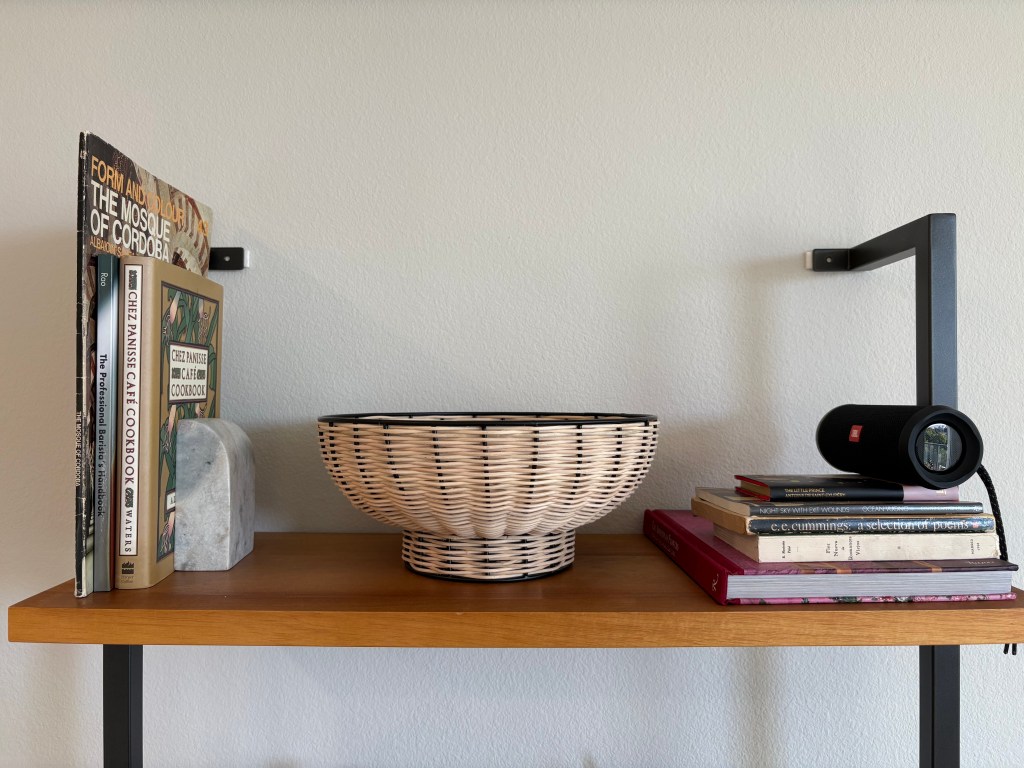
It has always been part of my future homeowner dream to have a floor-to-ceiling bookshelf wall bordering my dining room. As a foodie, it makes complete sense to me to mix food and literature. And I wanted my dining room to feel like a moody den, a low-lit stroll through a barrel room. Why would you not want to savor dinners and wine surrounded by warm walnut-toned wood, serif-font poetry titles, maybe a record player and vinyl shelf or two? Think Disney “Tale as old as time” come-to-life moment.
Some idealistic Pinterest inspo:
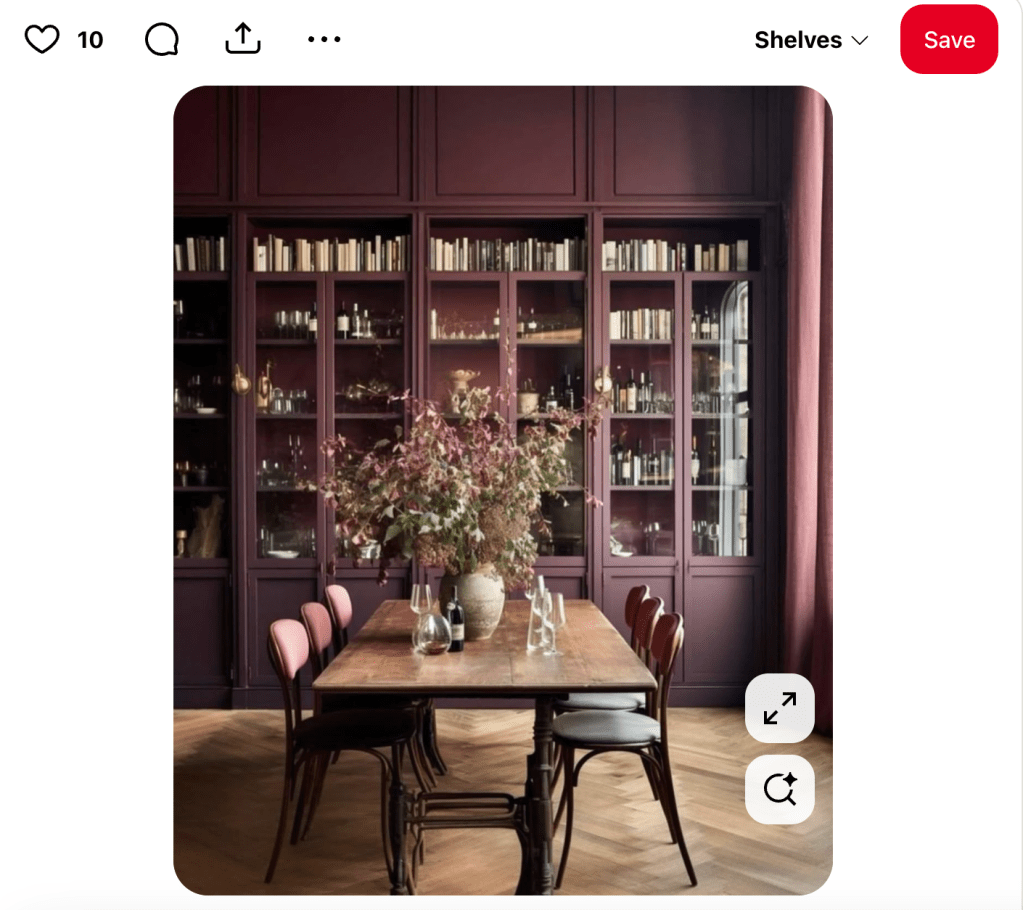
Reality Check:
Realistically, I live in a 1-bedroom apartment, and I am working with a 3 x 7 1/2 ft area of dining space (yes, I measured) sandwiched between the kitchen bar and the living room. But, I realized that in spite of the small space, it was still possible for me to have a little bit of dining shelf magic to tide me over in my renter’s purgatory.
1. The Physical Shelf:
First step, choosing a shelf:
In a small space, I prefer a more open shelving. Without outer walls, the shelf more smoothly blends with the small space, making the space overall feel tangentially more wide and open.
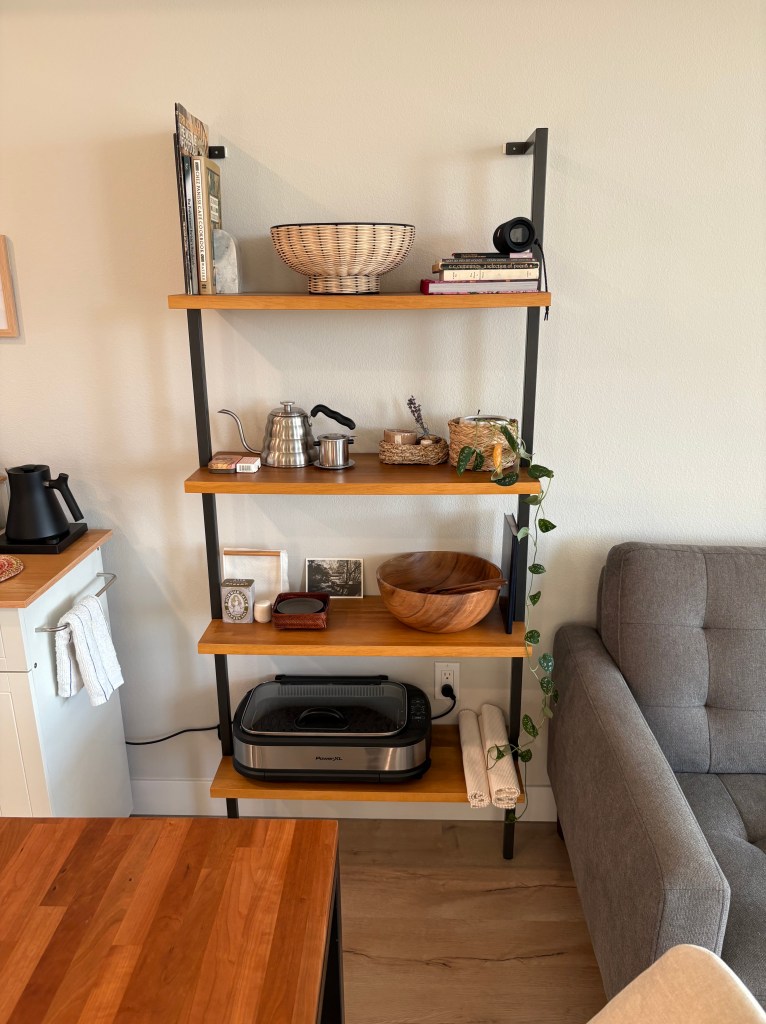
The shelf that I have is one I used on an odd wall in the living room of my old apartment, but won’t work in my current living room. It is a CB2 Helix shelf in a medium walnut tone that I found for a deal on Facebook Marketplace ($100 lightly used). Since it is the older version of the shelf, it is shorter (72″) than the newer version they currently sell (96″), but I find that it works in my dining space since the wall I planned to mount the shelf on has an overhanging ceiling that actually shortens the wall as well.
The shelf’s wood tone and black metal pipes match my dining table (Room and Board Parson’s butcher block, another lightly used Facebook Marketplace steal!) so it lends some cohesiveness to the dining area, and visually defines the space from the kitchen, coffee bar (another post on the way!) and living room which are furnished with lighter toned woods.
Some other shelf options I would consider: Ladder shelves, Floating shelves, Arch shelves, Cube shelves, Consoles or media cabinet shelving
This article explains different types of shelving.
On a Budget:
I recommend buying used if you can, since there can be some great deals, and often, quality shelves are built to last. For the DIYers, another budget option could be to build your own shelf. Floating shelves seem especially more of a simpler project, or you could even build a shelf with customized cubbies.
Renter Friendly Tip:
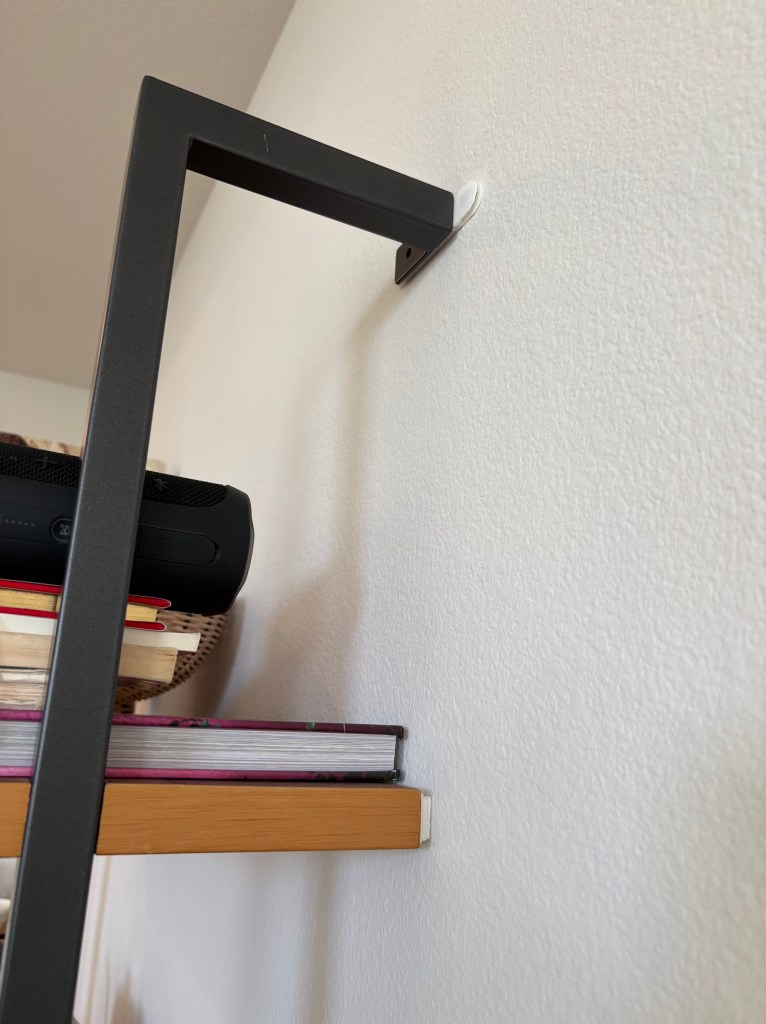
If you are not able to put holes in the walls but need to secure your shelf, XL Command Strips can be an answer. I’ve used them a number of times over the years, and have found them reliably grippy and non-paint stripping every time when used and removed according to the instructions (you need to pull the tab closely parallel against the wall, not outwards from it!).
My current shelving is secured with Command. (I do have a drill and my landlord allows it, but my husband is still mentally scarred from pulling out anchors in our last place.) I just stuck the strips behind the metal screw plate and on the back of each shelf plank.
2. The Objects
Once you have the shelf secured, it’s time to start gathering things to put on it. Now, while the dream was a dining room library, realistically I do not actually have that many physical books since like other late twenties adults, I have had to move way too much and I actually am an intensive Kindle reader. Since I am also living in a small space, I wanted to maximize my shelf space for storage purposes as well.
I am a firm believer that it is unnecessary to buy purely decorative items (unless it truly just brings you lasting joy). Instead, if you invest in items that are first functional and second aesthetic, they can serve a dual purpose.
My Dining Shelf Criteria:
I tried to gather objects that were:
- things I already had and needed to store (no need to buy anything new!)
- dining-related, and that I used occasionally enough to not store them in the back of a cupboard, but not regularly enough that they would be off the shelf more than on the shelf (had to do some mental math here)
- harder/ more annoying to store in cupboards (being on a shelf means it is more easily reachable)
- aesthetically pleasing, or just made me happy to see everyday
A bit of shelf philosophy…
What’s on your shelf is often what people look at to learn more about you. Displaying items with stories, memories, identity-revealing details can make a shelf more complex than just decorative. Think about what has potential to be a dinner-with-friends conversation starter.
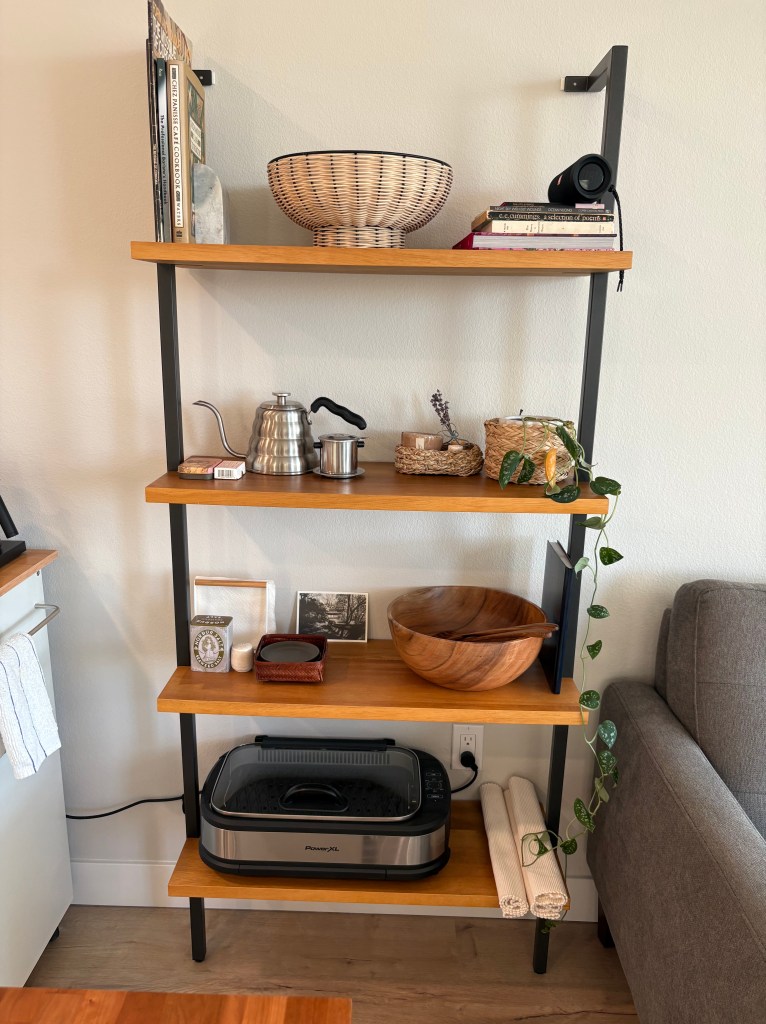
From top to bottom, here’s what ended up on my shelf:
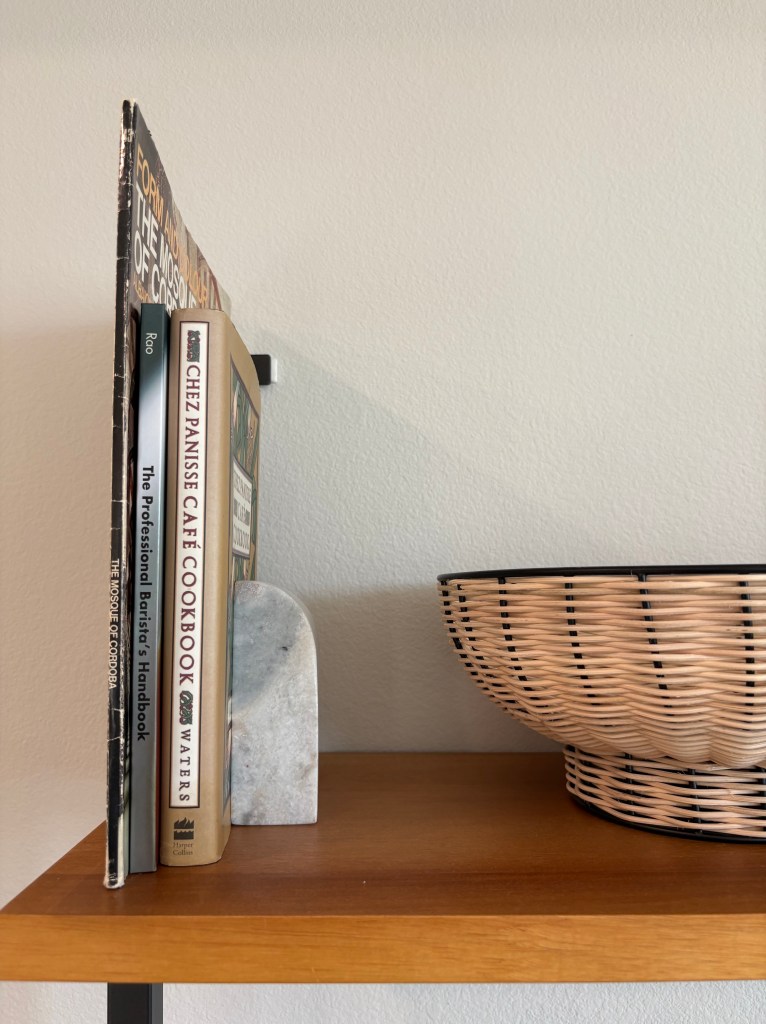
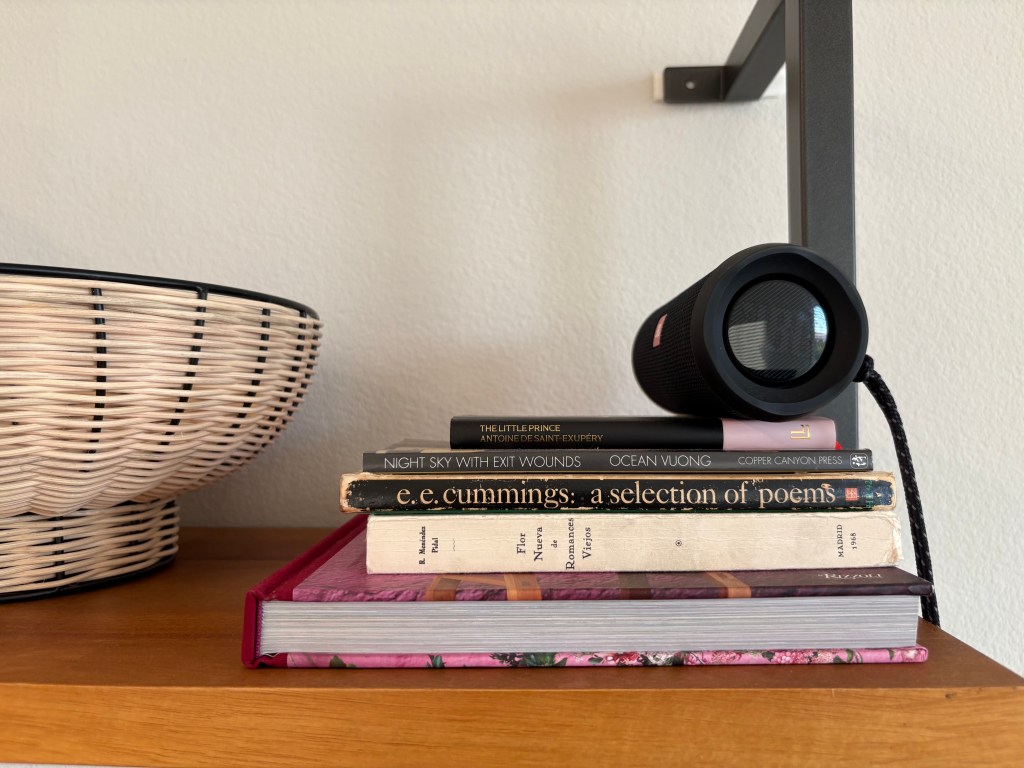
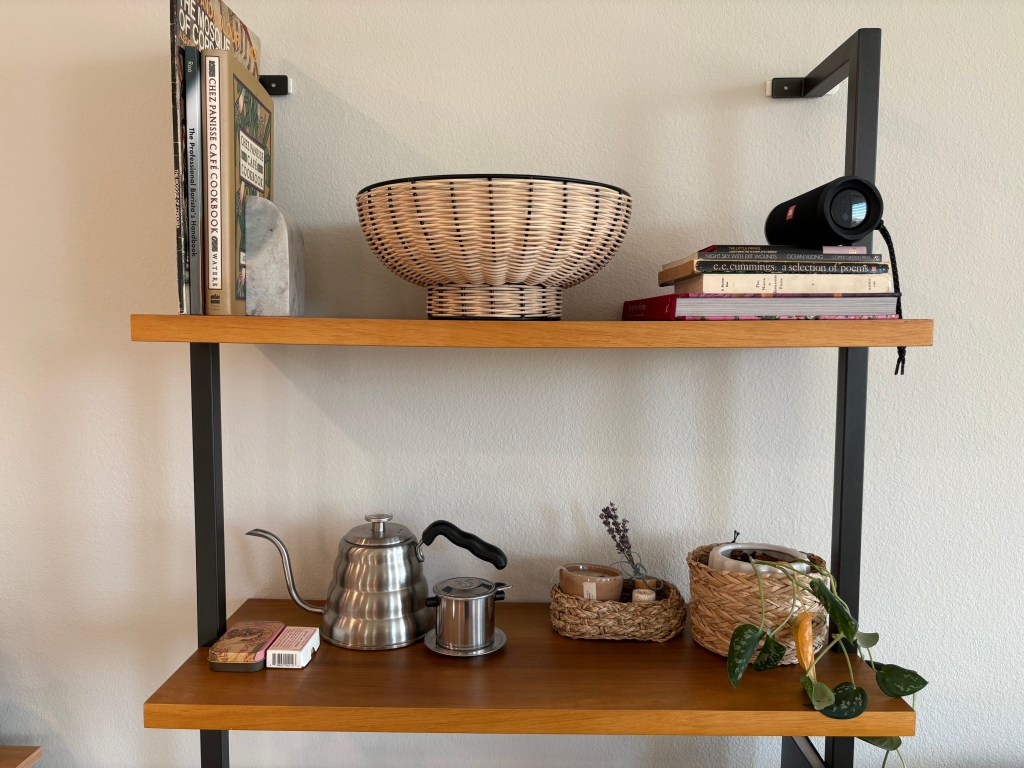
- Select books: A barista book, a Chez Panisse cookbook (since my husband and I met in Berkeley), two books I bought from street vendors while traveling, two poetry books I like, a gifted Portuguese copy of The Little Prince, a floral arranging book I used to use as a coffee table book
- Portable speaker
- Functional fruit basket that I can still put fruit in while it sits on the shelf
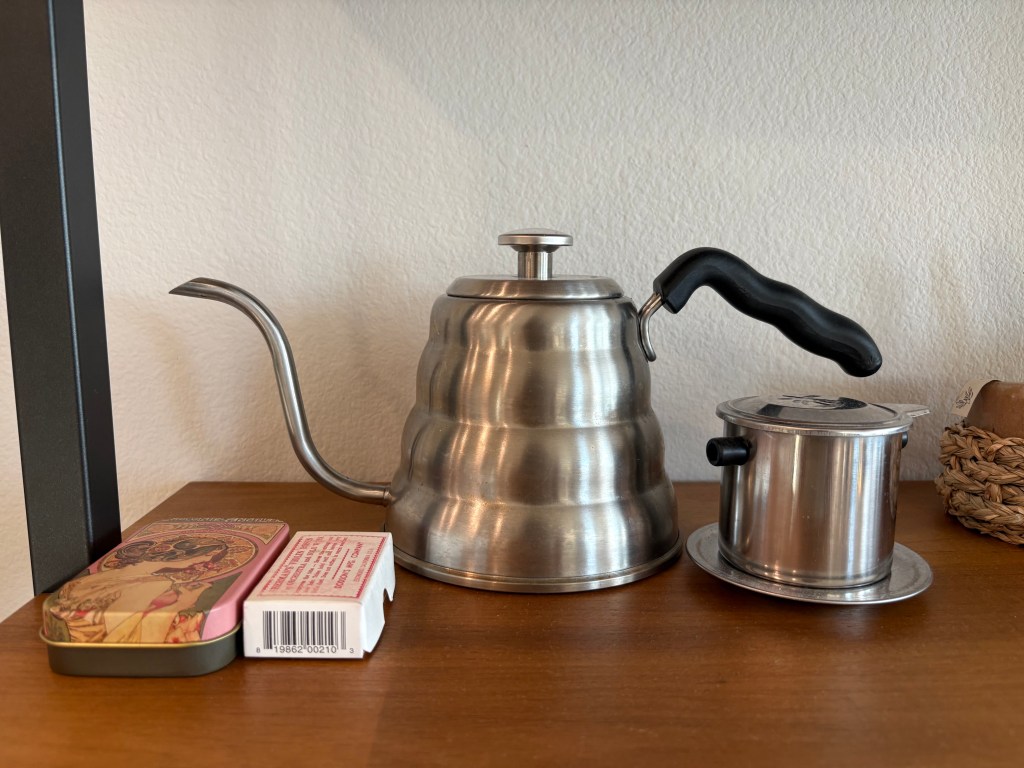
- Lesser used coffee tools: Pour-over stovetop gooseneck kettle, Vietnamese coffee phin
- A mini chocolate tin (bought as a Barcelona souvenir, though fun fact: I actually collect these when traveling) repurposed for holding safety pins, a box of violin rosin (my husband plays)
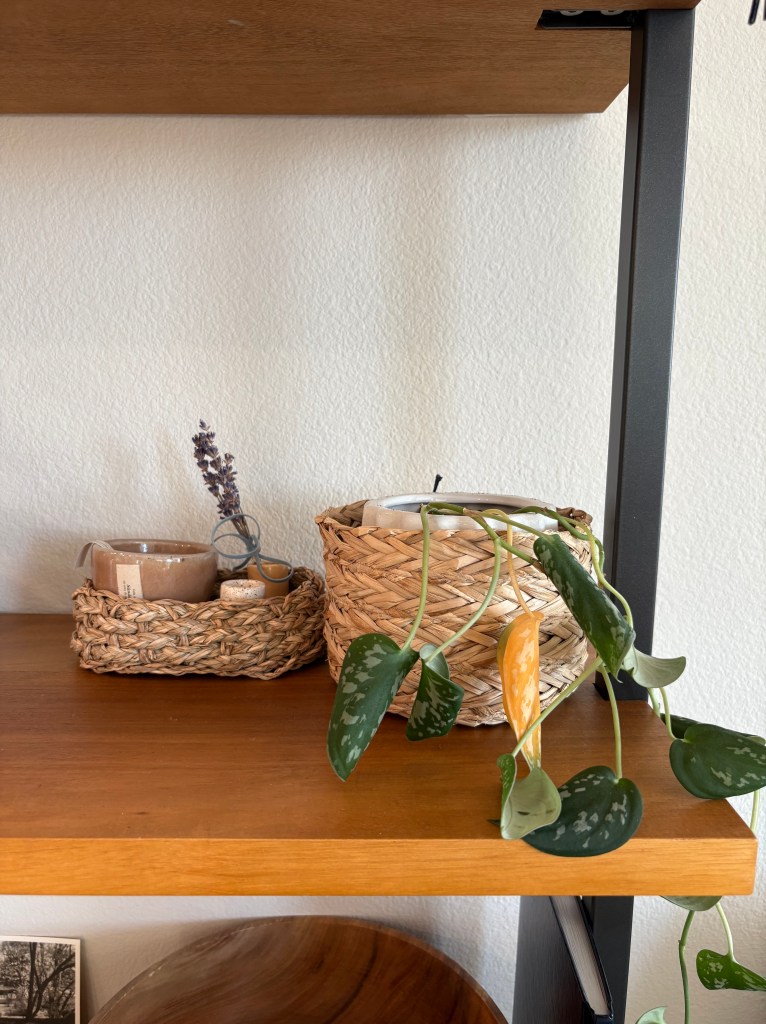
- A pothos strand houseplant, handmade candle (a Mexico City souvenir), two ceramic candlestick holders, a sprig of dried lavender (randomly, from a gift wrapping), matching baskets – one I bought in Spain, one I bought at Target
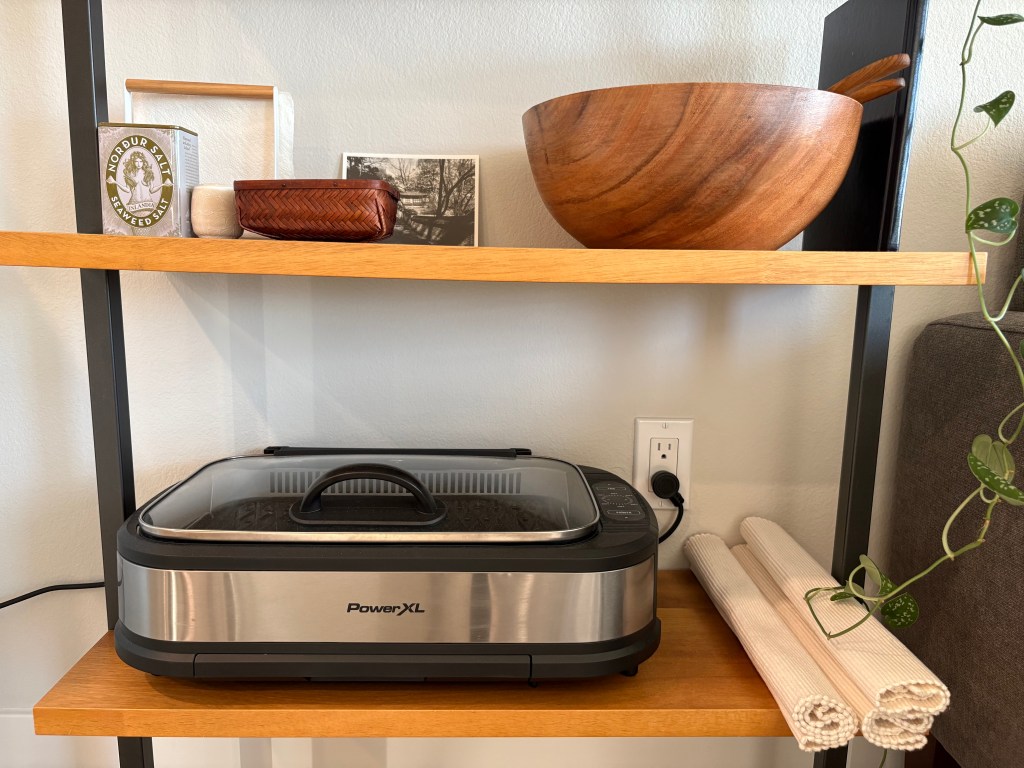
- Dining table accessories: Napkin holder + napkins, salt shaker + Icelandic sea salt box (a gift from my sister), coasters in a basket holder, a postcard with a handwritten message from a friend
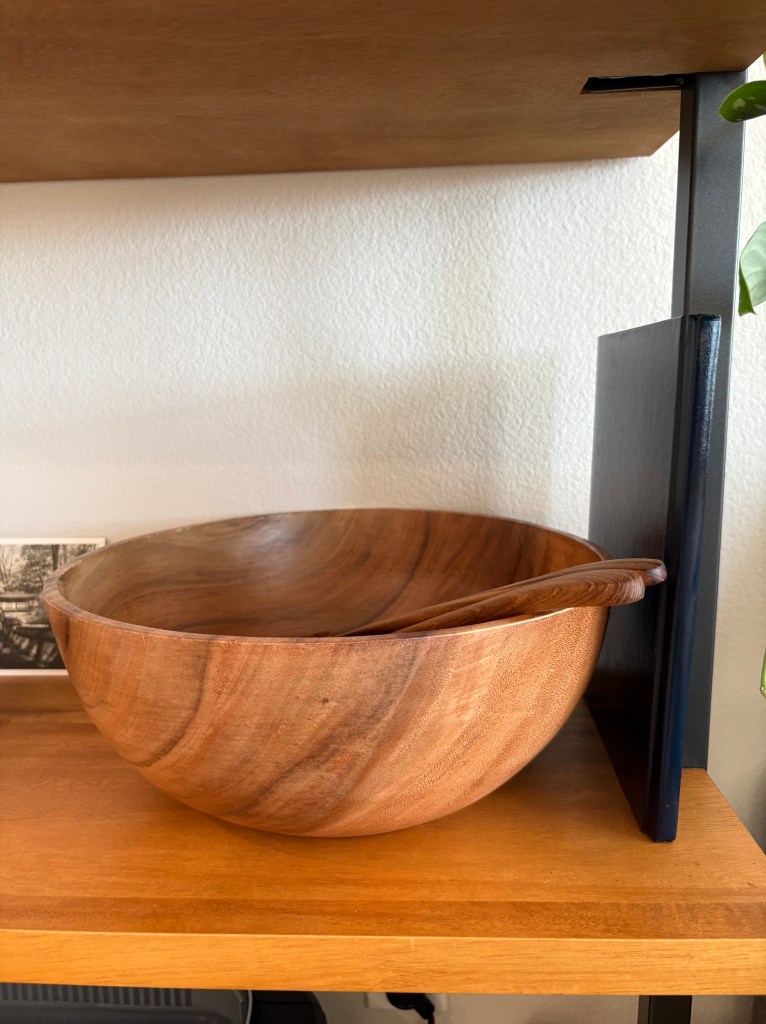
- Wood salad bowl + utensils, a recipe book I started handwriting in a notebook with my husband
- An indoor k-bbq smokeless grill (was gifted a spare by my mother-in-law) + some dining placemats we use for our coffee table Netflix dinners
Some additional ideas:
- Vases, vessels, flower frogs, dried florals/ herbs, houseplant propagation stands
- Carafes, pitchers, drinkware, ceramic vessels
- Trays, decorative bowls
- Wine + wine rack, wine glasses (try hanging them upside down on your shelf)
- Art, framed photos, photo books, cameras
- Record player, vinyls
- Sculptural art, spare candles
- Phone stand/ charger
- Basket-type, covered small storage boxes to hold more items
3. The Arrangement
Earlier this summer, I was on a girls trip to Mexico City, and we stayed at this Airbnb (5/5 would recommend) with such impressively cozy styling and shelving (I was in love with the hallway lined shelving displays that just made you want to dawdle on your way to the bedrooms). It was here that I realized something simple about shelf-styling:
It’s all about intentional clusters and making subtle cross-cluster threads.
1. Clusters
I received a valuable piece of advice when I was taking a nonfiction memoir writing class. Start with the single moments and standalone chapters, not the entire book outline. Let those take you to the final ending. I find this same concept applies to shelf designing. Instead of beginning with a set vision, start by just making clusters, or smaller groupings, of your objects that go together naturally and visually.
You can cluster by:
- colors
- shapes and sizes
- materials
- object types/ genres
Clusters should not be too homogenous, but should be micro-styled curations of eclectic, yet cohesive elements. Think of it as good granola, you want variety, but it should still taste delicious when chewed into mush all together.
My clusters:
- Books: Patterned covers on one side which I paired with a marbled bookend that matched the multi-colored look, Pinks, blacks, and cream colors on the other side
- Silver metals: my gooseneck and phin. Since these were a pair, I also clustered the chocolate box and rosin box as a pair next to them as they were similarly sized and shaped.
- Candle + candle accessories were clustered together by type, and I added the lavender sprig and houseplant since it felt like it fit the “aromatic” and “naturals” category. To hold them and minimize the look of clutter, I fit them into matching baskets (material + color).
- Dining table accessories fit together genre-wise, but I also added the postcard since the black and white matched the gray of my ceramic coasters.
- Salad bowl + recipe book: I decided not to include my notebook with the other books since I wanted it to be more easily grab-able for when I want to jot down notes. I found that it fit best here since the navy color looked nice next to the wood tone and also matched the cherry color basket I had on the same shelf.

For statement-making items:
These are usually the larger items, which you can feel free to make stand-alones. These are usually harder to cluster, and can even draw the eye more when contrasted with clusters. Besides, they won’t really stand-alone as you’ll see in the next section.
Really, there are no “correct” formulas though. Trust your intuition and eye, and move around and experiment with your clusters.
2. Cross-Cluster and Vertical Patterns
To continue the book metaphor, if your clusters are vignettes, then you still need to tie them together with subtly woven threads in order to have a cohesive shelf. Think of this as making random, not-so-random coincidences appear across the different levels of your shelf.
Again, you can play with colors, shapes and sizes, materials, object types/ genres, but a little more sporadically this time than the tightly designed clusters. Try to cross-connect different clusters.
My vertical shelf threads:
- Basket materials across three shelves: the fruit bowl, set of baskets, and basket for coasters
- Gray, silver, black, metallic across four shelves: bookend + basket metal + portable speaker on first shelf, silver coffee pots on second, coasters and postcard on third, black and silver grill on the bottom
- Pops of white on all four shelves: book colors on first shelf, rosin box + one candlestick base on second shelf, napkin holder + salt shaker on third shelf, placemat rolls on last shelf
Other cross cluster patterns:
- Varying round shapes with rectangular shapes on each shelf:
- For example, the arched bookend, circular bowl, and cylindrical speaker are interspersed with the sharp cornered books on the first shelf. The oblong and circular baskets and coffee kettles are paired with the rectangular boxes on the second shelf. The salad bowl+ coasters + egg-shaped saltshaker on the third shelf are paired with the square basket + napkin holder and rectangular recipe book + salt box on the third shelf. On the last shelf, the grill is square, so the placemats are rolled into cylindrical shapes.
- Wood toned items to tie into the shelf material itself: The napkin holder rim + salad bowl + salad utensils help do this as well as the natural brown colors of the different baskets.
A Design Note:
Make sure not to overcrowd your shelves. Leave empty spaces in between clusters to visually separate them and continue to keep a curated open feeling.
How to know if you are finished:
Honestly, I think you will just know because it will feel right. But don’t stress about it being too perfect, or too tightly knit. It’s okay if it just doesn’t all connect. Just like in poetry, slant rhymes are more interesting than exact rhymes anyway. Besides, shelves can absolutely be rotating displays. The fun of having a shelf is in changing things up whenever you get bored or bring home new things (whoops), and getting to style it all again.
Concluding Thoughts:
In all of this late night writing, I’ve gotten to meditate on what shelves mean to me, and why I was so set on having a library-themed dining room in the first place. My dad loves to collect objects and I used to climb and explore the shelves of my childhood home discovering curiosities: shiny silver German steins with engraved scenes, ornate 4×6 frames holding family photos, rust colored ceramic vessels, animal figurine wood puzzles, books about investment and stock trading. My dad, a carpenter, also built me the first shelf I ever curated with my Barbie princess snow globe, my dog-eared and worn Harry Potter books, my Nintendo DS games. When I visit other people’s homes, my eyes naturally are drawn to exploring their shelves, and the unique personalities and individual moments they create in a home, big or small.
I suppose the takeaway is that shelves can be filled with wonder and history, captured in our eccentricities, our mementos, and the regular objects that fill our lives. Hopefully, your shelf can be more than a dust-collecting piece of furniture, and invite a touch of artful expression into your functional home.
…
If you have any photos, ideas, or opinions for shelf styling in a small apartment, I’d love to hear about it!
 zillenial nest
Leave a comment